“Social Metabolism”
Šimon Chovan, Natália Sýkorová, Viktor Timofeev
September 10 — October 24, 2026
Curated by Peter Sit
nico bernath wien
Florianigasse 5a
1080 Wien
Social Metabolism borrows its title from Karl Marx's Stoffwechsel — literally, exchange of matter, or metabolism. Marx used the phrase gesellschaftlicher Stoffwechsel for the circulation of commodities and the organisation of social labour, and in Das Kapital (1867) described labour itself as the process by which people mediate, regulate and control their metabolism with nature. Metabolism here is a material exchange, not a figure of speech: societies draw matter from the natural world, transform it, and return it changed. Capitalism reorganises this exchange around production, circulation and accumulation, and the works in this exhibition follow what happens along that circuit — through bodies, infrastructure, and the technologies that keep it running.
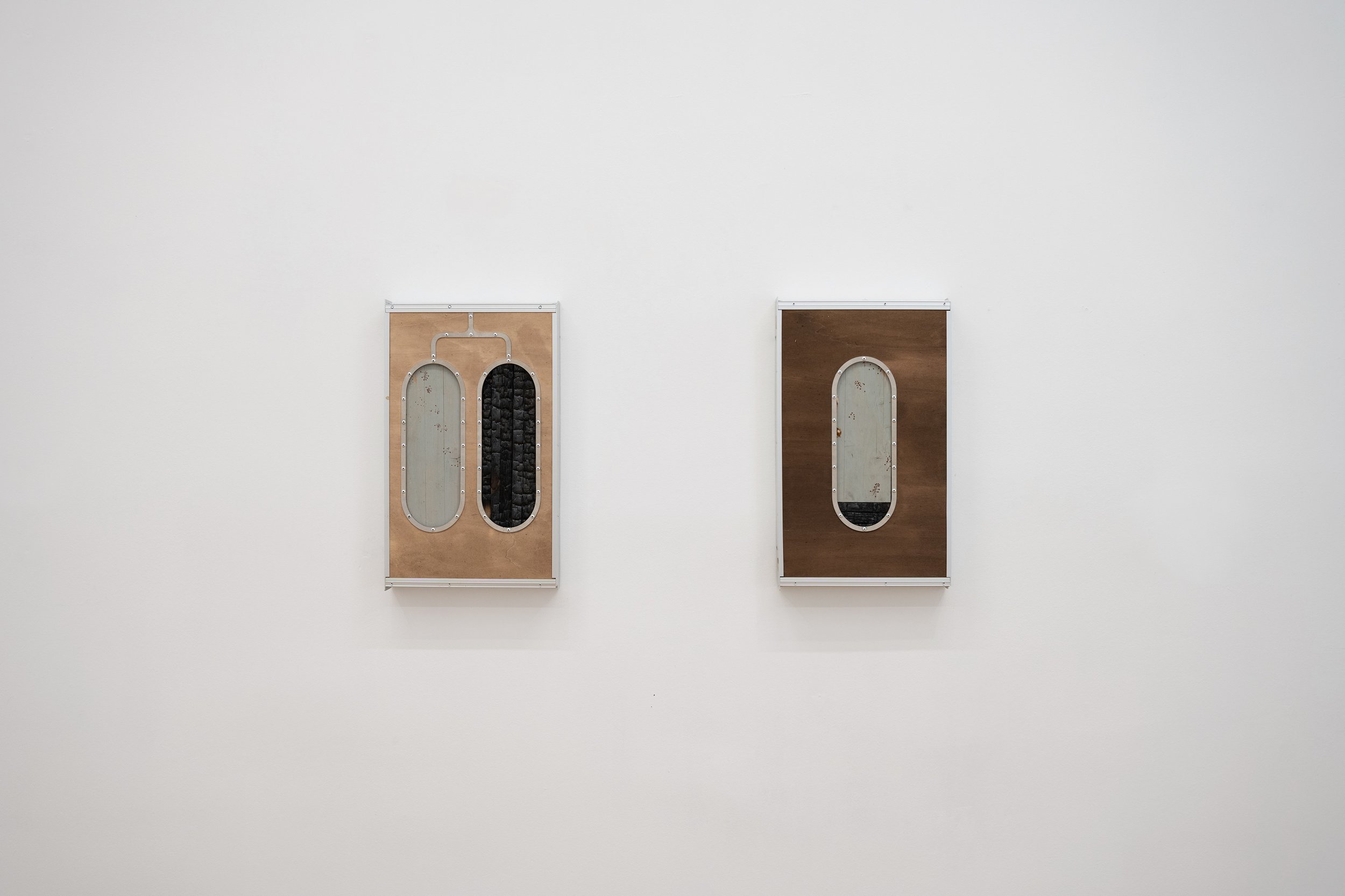
Šimon Chovan works with volcanic soil and ochre pigment carried from his hometown of Banská Štiavnica, alongside leftover residue from recycled car batteries or papier-mâché made out of old sci-fi or economical books. He casts and stages these substances, organic and industrial alike, into structures that hold the tension between what existed here before mankind and what we've made since, without resolving it. He is interested in tracing processes of industrial chemistry as metabolic processes, where the creation of an artwork becomes an intentional new step within these molecular chains.
ŠIMON CHOVAN
Šimon Chovan completed his MFA at the Sandberg Instituut in Amsterdam and previously studied at KASK in Ghent and the Academy of Fine Arts and Design in Bratislava. His recent solo exhibitions include Leeching States at MuseumsQuartier in Vienna (2025) and Dendrites & Tissues at TIC in Brno (2024). He has also participated in numerous group exhibitions, including presentations at Staffordshire St in London, Kunsthalle Wien, EXILE Vienna, Kunsthalle Bratislava, Kunstverein Eisenstadt, Diez Amsterdam, Greenfield Project Space in London, Tranzit Bratislava, Arti et Amicitae in Amsterdam, Galerie Lázně Liberec, MeetFactory, and Hraničář. Chovan’s practice is characterised by a strong material sensibility, bringing organic and inorganic substances into dialogue with materials such as ochre pigment, residue from recycled car batteries or paper pulp. Drawing on theories of extended metabolism, he is interested in strategies for intentionally situating the production of artworks within specific material flows and processes, aiming to balance intuitive approaches with criticality.
Šimon Chovan
Metabolic Archive I, 2026
wood, aluminium frame, rivets
61,5 x 36,4 x 7,2 cm
Šimon Chovan
Metabolic Archive II, 2026
wood, aluminium frame, rivets
61,5 x 36,4 x 7,2 cm
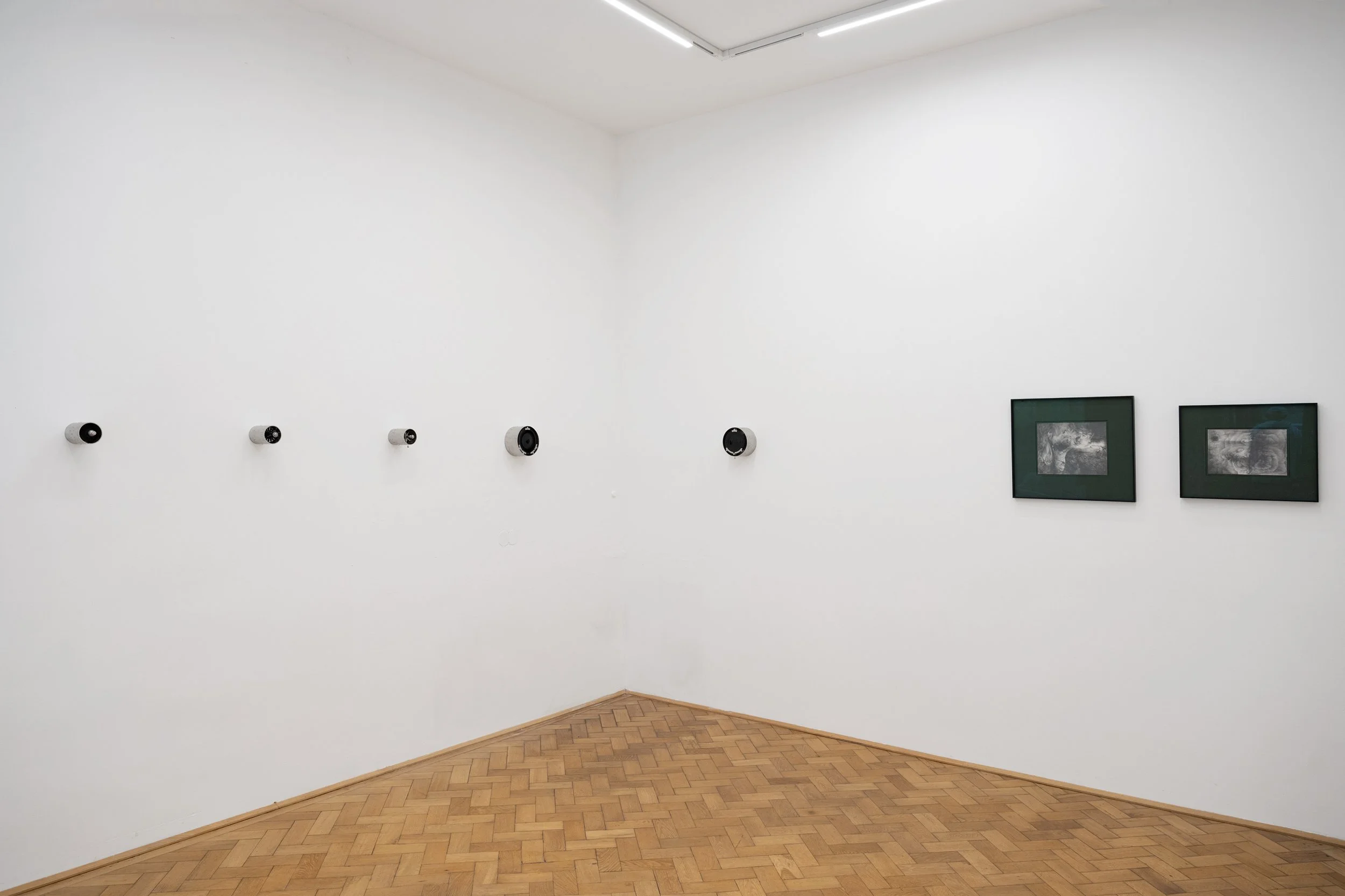
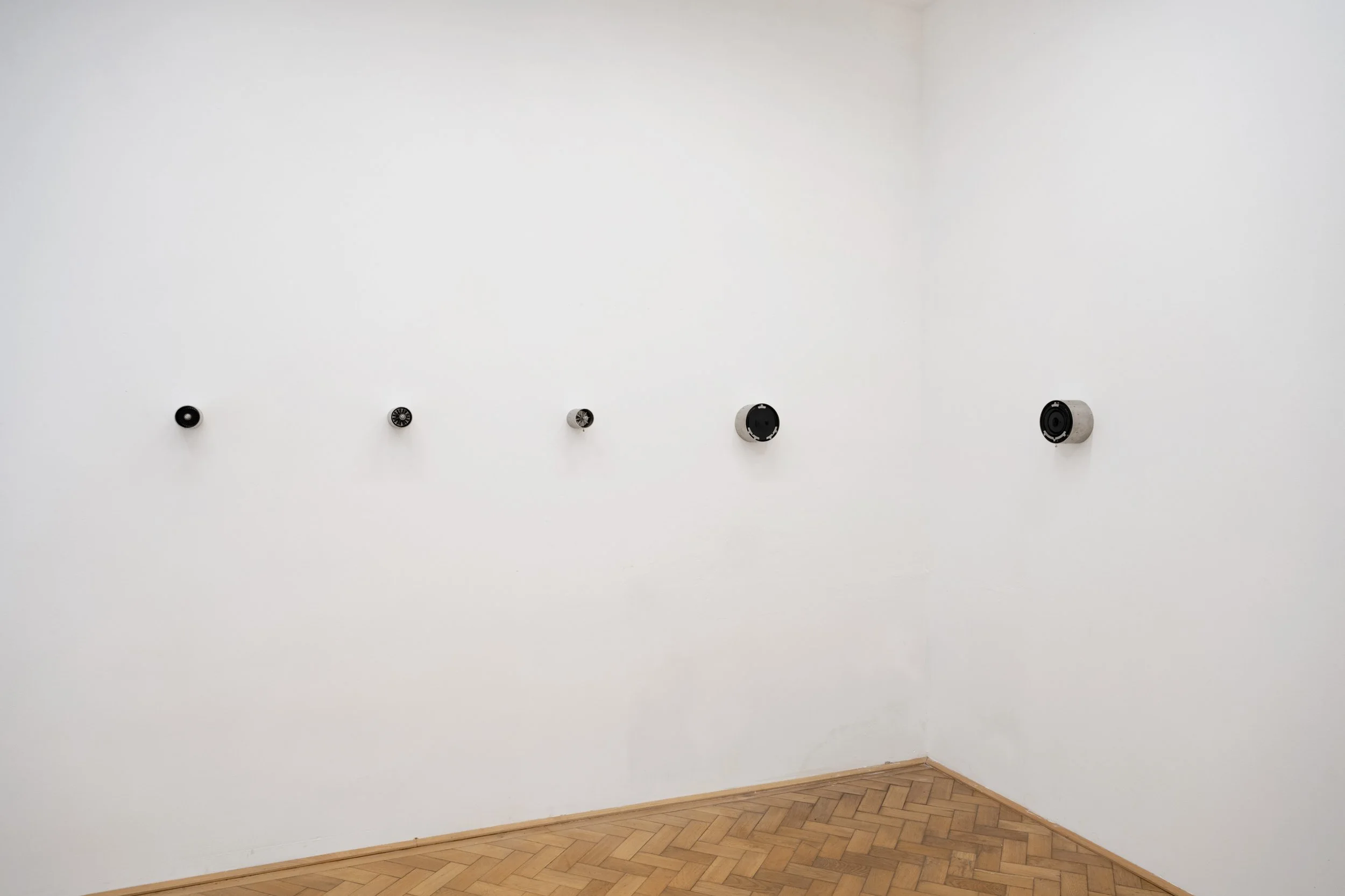
Natália Sýkorová's instrument series treats cryptographic infrastructure as a contemporary cosmology — a system of oracles, seals and thresholds built on the promise of a channel free of noise or trust. Their material logic is obsidian: volcanic glass, historically polished into scrying mirrors used to summon and negotiate with angels, now retooled into instruments of divination for an infrastructural age.
NATÁLIA SÝKOROVÁ
Natália Sýkorová is a visual artist and researcher based in Prague. Her work looks at infrastructures, either technological, ecological, or biochemical, and the systems of belief and control built into them. Working across sculpture, sound, and installation, she stages speculative scenarios where machined steel armatures, biomorphic cast panels, and ritual vessels appear as partly-bodily instruments. Hoses and fittings connect sealed containers to structural frames, suggesting circulation systems whose function remains withheld. Her work reflects on the hidden transmissions that infrastructures carry onto our bodies, and decide who or what gets protected, made visible, or left exposed. Sýkorová studied at the Bartlett School of Architecture at University College London and completed her postgraduate studies in Fine Art at the Academy of Arts, Architecture and Design in Prague (UMPRUM). She is currently a doctoral researcher in Digital Arts at the Academy of Fine Arts and Design in Bratislava. Her work has been presented at Kunsthalle Bratislava (2023), MuseumsQuartier Vienna (2023), where she was also a Q21 resident, ACUD Galerie Berlin (2024), City Gallery Prague (2025), and MeetFactory Prague (2025). In collaboration with Crosslucid, her work was presented at the House of Electronic Arts Basel (2025). Upcoming presentations include the International Centre for Graphic Arts in Ljubljana, BWA Wrocław, and GJK Trnava.
Natália Sýkorová
Nebulae I, 2026
stainless steel, brass, alumnium
20 × 20 × 40 cm
Natália Sýkorová
Sundew Mirror II, 2026
stainless steel, brass, bronze, alumnium
20 × 8 × 8 cm
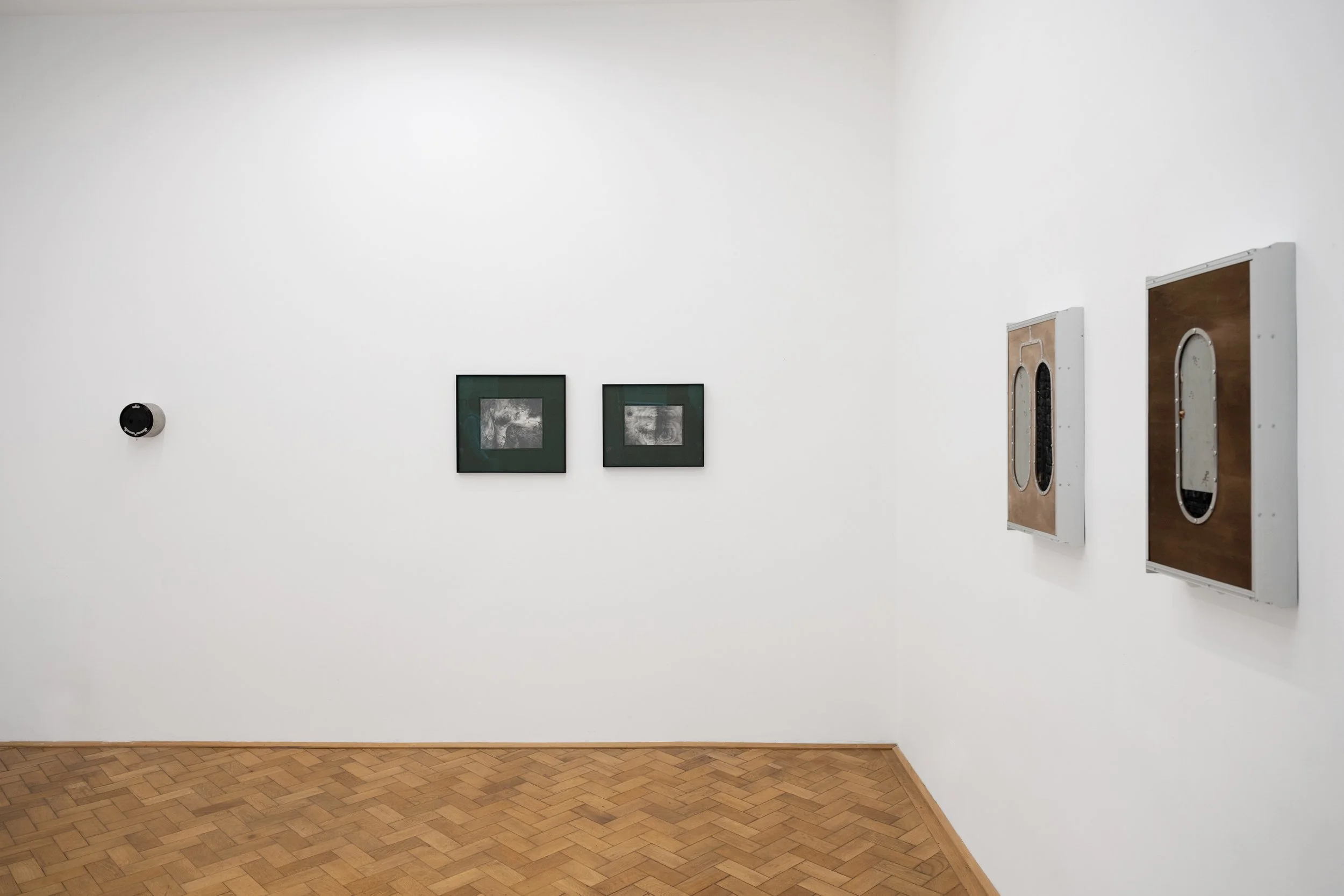
Viktor Timofeev's work moves through language, technology and systems of rules, unfolding over time without clear endings. A series of drawings shows the method at its plainest: paper and pencil, rotated every hour until observation gives way to improvisation. It's slow and repetitive labour.
VIKTOR TIMOFEEV
Viktor Timofeev is an artist from Riga, Latvia, living in New York. He makes drawings, paintings, videos, and installations that explore how personal experience connects to larger systems like technology, bureaucracy, and language. His projects often take the form of theatrical environments that reflect on how people navigate rules and meaning, tracing the friction between inner worlds and shared realities. Alongside his visual work, Timofeev produces experimental music that translates spatial thinking into sound, building layered sonic architectures that echo the logic and atmosphere of his installations. Recent solo exhibitions include the Latvian National Museum of Art in Riga, Latvia (2025), Editorial Projects in Vilnius, Lithuania (2025), Interstate Projects in New York (2021), and Karlin Studios in Prague, Czech Republic (2020). Recent group exhibitions include Gifts of Friendship at Museum Sztuki, Lodz, Poland (2026), 1st Klaipeda Biennial, Klaipeda, Lithuania (2025), 19th Tallinn Print Triennial, Tallinn, Estonia (2025), Malmö Konstmuseum in Malmö, Sweden (2025), Hessel Museum of Art, Annandale-On-Hudson (2025), Kohta Kunsthalle in Helsinki, Finland (2023), National Gallery Prague in Prague (2021) and the 14th Baltic Triennial at Contemporary Art Center in Vilnius, Lithuania (2021). Additional presentations include a solo evening at the e-flux Screening Room, New York (2025) and a premiere at the International Film Festival Rotterdam (2025).
Viktor Timofeev
Inner Speech, 2024
Graphite on paper
7,5 x 11 cm
Viktor Timofeev
Ventspils Iela, 2026
Graphite on paper
12,5 x 10,5 cm
Viktor Timofeev
Amory Court 3, 2026
Graphite on paper
10,5 x 12,5 cm
PETER SIT
Peter Sit is an artist and curator. He curated the Czech and Slovak Pavilion at the 61st Venice Biennale, bringing together Jakub Jansa and Selmeci Kocka Jusko in a joint presentation. The project, titled The Silence of the Mole, marked the 100th anniversary of the pavilion. Sit currently works as art director at e-flux journal. From 2012 to 2022, he was co-founder and member of the collective and platform APART, where he curated and developed a wide range of exhibitions, publications, and discursive projects. Through APART, he exhibited at institutions including Kunsthalle Bratislava, Karlín Studios in Prague, Easttopics in Budapest, the Biennial of Graphic Design in Brno, CCA Chronicle in Bytom, MoMA in New York, Glassbox in Paris, Alserkal Arts Foundation in Dubai, City Gallery Prague, Kunsthalle TRAFO in Szczecin, and the Matter of Art Biennale in Prague, among others. Sit has participated in international residencies including the Salzburg Summer Academy and Art in General, New York. His editorial and curatorial practice spans books, exhibitions, and public programs, including Woody and Steina Vasulka: Resonant Memory (e-flux, 2025), Harun Farocki: Shaping of Our Present (A Promise of Kneropy, 2022), Life, Death, Love and Justice with Didem Yazıcı (Yapı Kredi Culture Centre, Istanbul, 2022), and the 9th Futurological Congress: Future of Language with Julieta Aranda (Slovak Radio Building, Bratislava, 2019). He has organized and contributed to numerous lectures and discussions on conceptual art in relation to art education and mental health. He is currently working on a research and writing project, Art in Times of Anxieties and Depressions.
Peter Sit
Curator of “Social Metabolism”
Photo by Neven Allgeier